Libraries and Archive
The College Libraries
Queens' has two libraries, both of which are located in the oldest part of the College.The War Memorial Library supports junior members, providing a study space and core resources across the range of tripos subjects. The Old Library houses the College's manuscripts, rare books and other special collections and documents.
The War Memorial Library
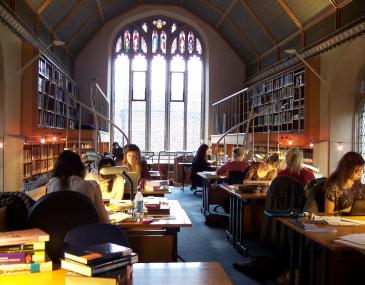
This library is housed in the College's original 1448 chapel and is named in commemoration of the members of Queens' who were killed during the Second World War. It is located in Old Court and entered from Library Passage, which links Old Court and Walnut Tree Court. It was refurbished in the 1990s and provides modern facilities in surroundings that have been sympathetically restored.
Access
Current members can gain access using their Cambridge University Cards. Old members and visiting scholars can visit during vacations by prior arrangement with the College Librarian. The library has no lift and upper areas are reached using spiral staircases. Library staff will be pleased to assist any member experiencing difficulty using any of the library facilities.
Library Opening hours
The Old Library is open to visitors by appointment with the College Librarian (contact details below). Opening hours of the War Memorial Library are:
Michaelmas and Lent terms: 7am until 2am daily
Easter term: 24 hours
Christmas vacation: 7am until 10pm daily. The War Memorial Library closes for a few days over the Christmas and New Year period. Details will be posted nearer the time.
Easter vacation: 7am until 2am daily
Summer vacation: 9am until 10pm daily, but closed to readers from 1st to 31st August inclusive.
Finding Books
The collection comprises resources to support all tripos subjects and some postgraduate courses. It also includes reference and local collections and bound copies of past exam papers.
The College's Heritage catalogue can be searched on the local area network only.
Queens' books can also be identified using the Newton catalogue, which is hosted by the University Library and includes the holdings of most College and Departmental libraries. It can be found on the Newton Catalogue.
Both catalogues give location information; the former also shows whether items are available for loan, and offers recall and renewal options. Queens’ uses the Bliss classification scheme and subjects are ordered alphabetically according to class mark. The shelf sequence begins on the ground floor, which also houses the main reference section. The library has several floors and maps showing subject locations can be found in the lobby, and via the Enquiry screen of the catalogue search terminals.
Electronic resources
A range of ebooks, ejournals and databases is available within the University and library staff will be pleased to advise on the use of these resources.Information about ebooks and how to access them can be found at: Ebook information
Information about access to ejournals and databases can be found at: Ejournal & database information
Borrowing, Reserving and Renewing Books
Queens' has a self-issue system and current members can borrow up to 10 items for 14 days. Recall, reservation and overdue notices are sent by email and overdue books attract fines, which are added to termly bills. Details of end of term recall dates and vacation loan periods are posted on Library notice boards.
Purchase Requests
Members can request new titles by contacting the College Librarian or completing one of the request cards that are kept by the enquiry terminals in the lobby. Orders for books that are not on Part One reading lists must be countersigned by a Director of Studies. An online request form is in preparation.
Computing
Network points and Lapwing wireless access enable portable computers to be used on the Mezzanine and in the Law Library. For the convenience of others, readers are requested not to use laptops on the ground floor. Extensive computing and printing facailities are available in the Essex building. Photocopies can be made in the library using the Cambridge University Card, with charges being added to termly bills.
Contacts and Library Staff
College Librarian: Mrs Karen Begg, MSc (Econ) Email: librarian@queens.cam.ac.uk
Assistant Librarian: Mrs Miriam Leonard, BSc (Econ) library@queens.cam.ac.uk
Fellow Librarian and Keeper of the Old Library: Dr Ian Patterson Email: ikp1000@cam.ac.uk
Fellow Archivist: Dr Craig Muldrew Email: archive@queens.cam.ac.uk
The Old Library and Special Collections
The Old Library is open to visitors on certain formal occasions throughout the year. The College Librarian also arranges exhibitions and private visits. Scholars and student study groups are welcomed and specific items from the collection can be consulted by appointment.
Old Library History
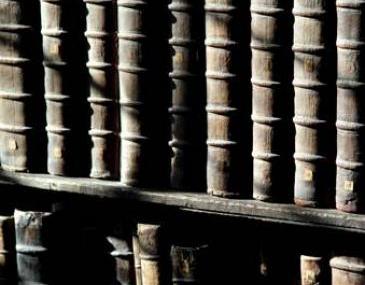
The Old Library was completed in 1448 and, although none of its original collection remains, it contains many important manuscripts and early printed books, and some beautiful bindings. It has benefited from generous bequests, notably the Isaac Milner bequest of eighteenth-century French mathematical works and the Renaissance Humanist library of Thomas Smith. It also contains a representative collection of the works of Erasmus.
Conservation and Preservation
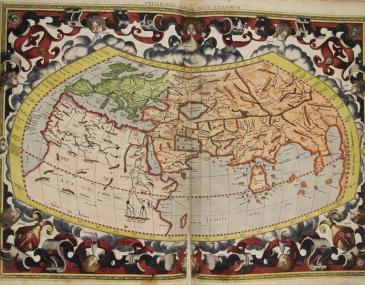
The Old Library collections are used by students and researchers from around the world but continued access to its old, often very rare, books requires careful maintenance. The College invests in a small but active conservation and preservation programme for the fabric, books and manuscripts. Recently refurbished books include Anatomia, an important early 17th century medical book by Vesalius and Opticks (1704) and Optice (1706) by Isaac Newton. The generosity of old members and others has allowed us to undertake larger projects, including the restoration of the Library's 18th century terrestrial and celestial globes made by John Senex.
Special Collections
These include the Cohen Collection of books, pamphlets and other material bequeathed to Queens’ by J.M. Cohen, translator and literary reviewer. Cohen built his collection out of gifts from the authors or purchases made during visits to Spain and Argentina in the 1950s and to Mexico and Cuba in the 1960s and 1970s. It includes signed copies of works by writers of the first Cuban revolutionary generation; works by women, most of which were previously unrecorded in the West; an extensive collection of Soviet Russian literature; and studies on literary criticism and poetry, the pre-Columbian American past and Nahuatl literature.
The Kennett Collection is another valuable 20th century bequest. It comprises Old Testament and Semitic texts and was given by Robert Hatch Kennett in 1932. It is now housed in the library of the University's Department of Asian and Middle Eastern Studies, to which all enquiries should be addressed.
There is also a Members' Archive, which is a collection of works by Fellows and past Fellows of the College, and (mostly literary works) of current and former members. Details of more recent publications form the core of an electronic database that will eventually be accessible from the College web site. Old members who would like their monographs to be added to this catalogue are welcome to send bibliographic details to the College Librarian.
Recent Developments
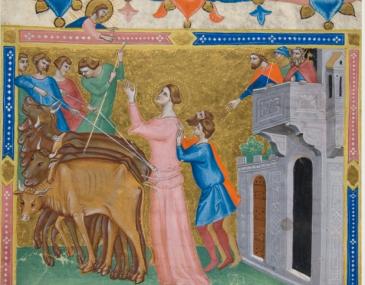
The Old Library is home to rare books and historical documents which, despite their age, provide a continuing source of interest and discovery. For example, during research for another project in early 2007, three illuminated manuscript miniatures were identified as the work of Pacino di Bonaguida, an eminent Florentine artist and illuminator of the early 14th century. The works are leaves from a laudario, a manuscript containing songs of praise in Italian, that is believed to have been commissioned by worshippers at the church of Santa Maria del Carmine in Florence. Each depicts the martyrdom of a particular saint and is richly decorated in vivid hues and gold leaf. Art historians and manuscript curators at the Fitzwilliam Museum in Cambridge and the Getty Museum in Los Angeles have examined the miniatures and been able to add more to the growing body of knowledge about Pacino and his work. None of the laudario's leaves remains in Italy, but twenty-odd have been discovered around the world and it is hoped that the these might one day be brought together, perhaps in a digital format. Images of the Queens' leaves will be added to the College website in due course. The Cambridge leaves will feature in an exhibition about Pacino and his work that will be held in 2012 at the Getty Centre, Los Angeles.
The life and work of Sir Thomas Smith (1513-1577) has been much studied. An alumnus of Queens', scholar and eminent Elizabethan, he retained an interest in the College, to which he gave generously during his lifetime and to which he also bequeathed his library. In 2007, his more unusual legacy of jottings and doodles has attracted attention. The jottings take the form of two commonplace books, which are manuscript records of his day to day preoccupations. These are held in the Old Library and have been digitised as part of the Cambridge University English Faculty 's 'Scriptorium project', a project that will give free online public access to a number of simlilar documents. For more information see: http://scriptorium.english.cam.ac.uk/
The College recently received a copy of a 2009 publication by the Society of Antiquaries entitled Hill Hall, a singular house devised by a Tudor intellectual, by Paul Drury and Richard Simpson. This represents many years of research into the architectural history of the Sir Thomas Smith's Essex home which, despite an eventful history, still survives.
The College Archive
Most records relating to the College’s history and estates prior to 1800 are kept in the Archives Department of the University Library.They can be viewed on request in the Manuscript Reading Room but finding aids are limited as the documents are not yet listed online. Details of University Library admission arrangements can be found at : http://www.lib.cam.ac.uk
The personal papers of several former Queens' members are kept in the Old Library and will eventually be added to Janus, the online database for archives in Cambridge University that can be accessed via the University Library at :http://janus.lib.cam.ac.uk/
Requests for information about this material should be addressed to the Fellow Archivist: Dr Craig Muldrew Email: archive@queens.cam.ac.uk